
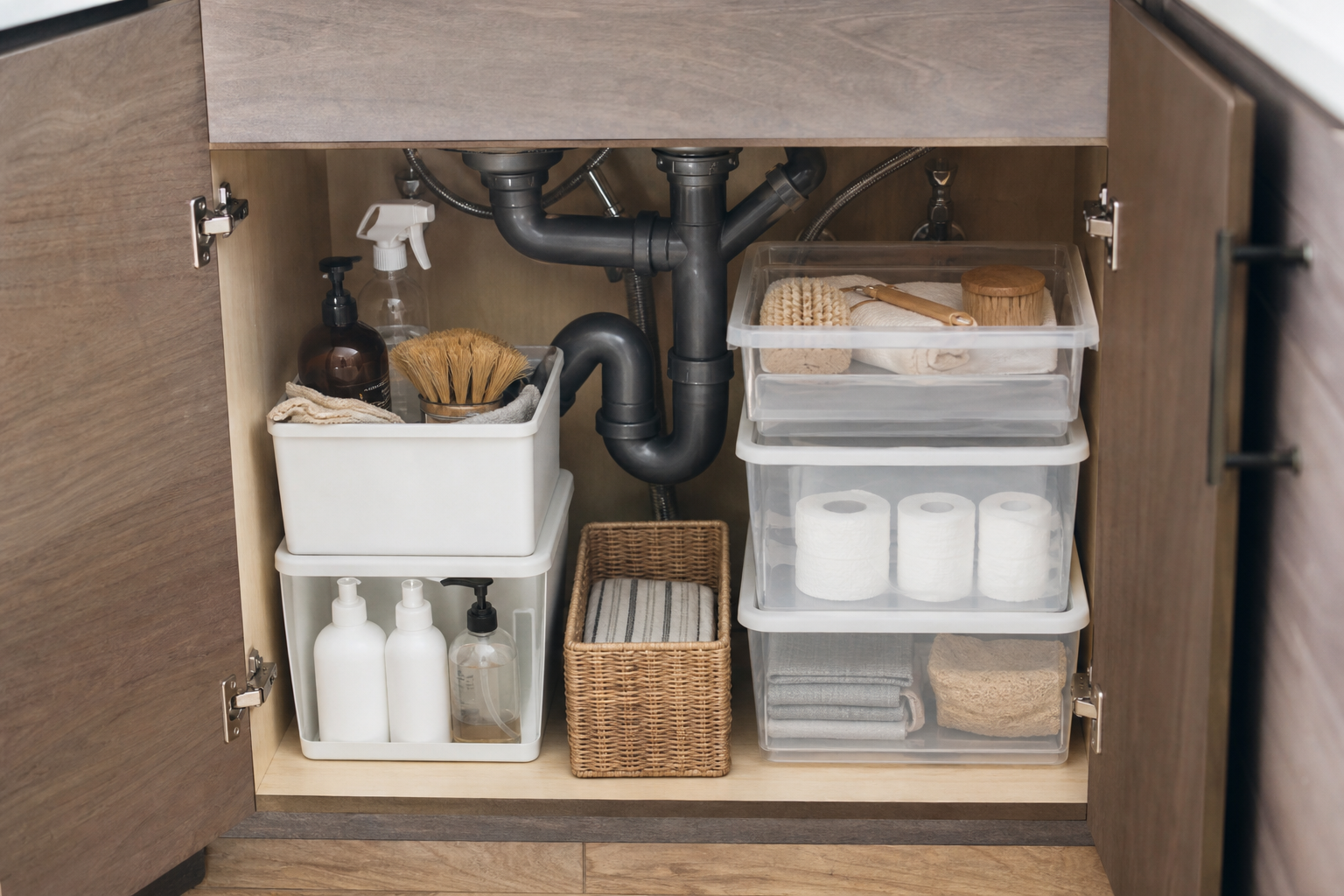
How to Organise Under Kitchen Sink in a Small Space
If you’re wondering how to organise under kitchen sink in a small space, keep it simple: store only the things you actually use at the sink, contain them in small bins, and keep the plumbing and shutoff valves visible. In a cramped cupboard or cabinet, less really does work better.
The goal is not to cram more in. It’s to make the space safer, easier to clean, and quicker to use when you’re reaching for washing-up liquid or checking for a leak.
What you need
- 2 to 4 small plastic bins or handled caddies
- 1 low tray or wipe-clean mat for the cabinet base
- 1 narrow lazy Susan or turntable if the pipe layout allows
- 1 tension rod or short rail for spray bottles if there is clear side-to-side space
- Adhesive or over-door storage for light items only
- Microfibre cloth
- Warm water and washing-up liquid
- Labels if you want them
Time: 30 to 45 minutes
Difficulty: Easy
Safety notes: Keep cleaning products in their original containers with labels intact. Never mix cleaning products. Do not store food, pet food or anything absorbent that could be damaged by damp under the sink. If children are in the home, fit a child lock to a low under-sink cabinet. Test adhesive organisers on a hidden area first, and check the manufacturer instructions for your cabinet door, liner or organiser before attaching anything.
What should and should not live under the sink
This is where most under-sink setups go wrong. The space is convenient, so it slowly turns into a dumping ground.
A better rule is simple: only keep items here that are used at the sink and can handle a bit of moisture.
| Good to keep under the sink | Better stored elsewhere |
|---|---|
| Washing-up liquid / dish soap | Dry food and snacks |
| Dishwasher tablets or pods if stored safely | Tea towels and cloths you want to stay dry |
| Sponges, brushes and bin bags | Paper towels in bulk |
| One all-purpose cleaner | Large backstock of cleaning products |
| Rubber gloves | Pet food or baby items |
| Small recycling liners or rubbish bags | Anything that blocks valves or traps moisture |
Dry foods should not be stored under a sink or near pipes. Cleaning chemicals should also be kept away from food and food-contact items.
If your cabinet is tiny, be strict. Keep daily-use items here, and move backups to a higher utility cupboard, pantry shelf or laundry area instead.
How to organise under kitchen sink in a small space: step by step
1. Empty everything out
Take out every bottle, sponge, bag and random tool. Check expiry dates if you keep specialist products. Throw away empty bottles, worn-out sponges and duplicates you never use.
This step matters because under-sink cabinets are good at hiding clutter at the back. You can’t plan a useful layout around mystery items.
2. Clean and dry the cabinet fully
Wipe the base, sides and back with warm water and a little washing-up liquid. Dry it well, especially around pipe joints and in the back corners.
If you spot a damp patch, deal with that before organising. Wet areas should be dried quickly, ideally within 24 to 48 hours, so they don’t turn into a mould problem.
If the cabinet doors are greasy, this guide on cleaning grease off kitchen cabinets can help.
3. Check for leaks and locate the shutoff valves
Before anything goes back, look at the pipe joints, trap and cabinet floor. Even a small drip can ruin an organised setup fast.
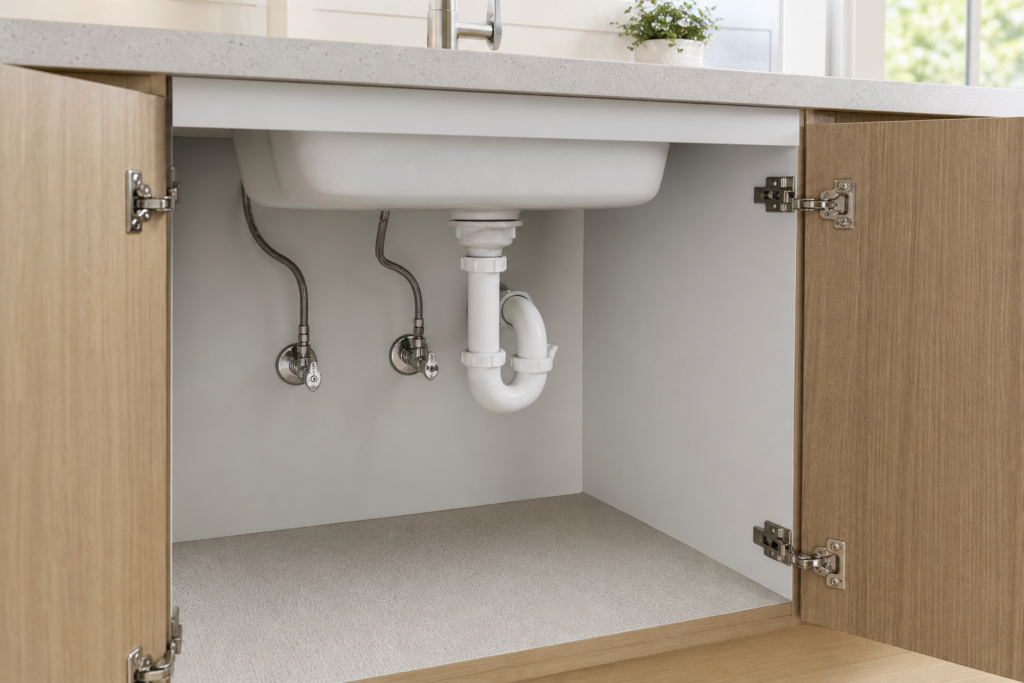
Make sure you can clearly reach the water shutoff valves. Don’t hide them behind stacked boxes or heavy baskets. If there’s ever a leak, you want instant access.
4. Measure the usable space, not just the cabinet
The tricky part is the plumbing. Measure the left side, right side, depth in front of the pipes, and the height below the basin.
In many UK and US kitchens, the best storage is not one big organiser but several smaller ones that fit around the pipework. A shallow bin at the front and two narrow bins at the sides usually work better than a deep basket that wastes half the space.
5. Sort items into three groups
- Use daily: washing-up liquid, dishwasher detergent, sponge refills, rubber gloves
- Use weekly: all-purpose spray, descaler, bin liners
- Store elsewhere: backups, rarely used products, anything bulky or moisture-sensitive
This step usually makes the layout obvious. Daily items go at the front. Weekly items can sit to the side or back. Anything else leaves the cabinet.
6. Build a simple small-space layout
For most small under-sink cupboards or cabinets, this layout works well:
- Front centre: one open caddy for daily-use bottles and gloves
- Left side: one small bin for dishwasher items or cloths in a washable pouch
- Right side: one small bin for bin liners, brushes and spare sponges
- Door interior: light items only, such as cloths, rubber gloves or a small brush
- Back area: only if accessible, for one or two backup products at most
If the pipe blocks the middle, use the side spaces instead. If the cabinet is very shallow, use low trays rather than deep bins so everything stays visible.
7. Use the right organisers for awkward pipes
You do not need a matching set. You need shapes that fit.
- Small bins: best for grouping loose items and lifting them out in one go
- Stackable half-shelves: useful only if they don’t block the plumbing
- Turntables: good for short bottles in one clear corner
- Tension rod: handy for hanging spray bottles, but only if there is secure space across the cabinet
- Door racks: good for lightweight items, not heavy bottles
If you like the look of decanted bottles, skip that here. Cleaning products are safest in their original containers.
8. Leave a little empty space on purpose
This can feel wrong at first, but it helps more than any organiser. A small gap lets you spot leaks, wipe the base quickly and avoid wedging bottles around the pipes.
If you store every spare item here, the cabinet will turn back into a clutter trap within a week.
Easy layouts for different under-sink cabinets
Very narrow cupboard or cabinet
Use one slim caddy for daily supplies and one door hook or narrow rack for gloves and cloths. Keep nothing at the back that you can’t reach without kneeling down and unloading the front.
Wide cabinet with a central pipe
Split the space into left and right zones. Put dishwashing items on your dominant-hand side and cleaning products on the other. Keep the centre open around the pipe.
Deep cabinet with lots of wasted back space
Use handled bins so you can pull categories out like drawers. If you can’t easily see the back row, you probably have too much in there.
Mistakes that make a small under-sink space worse
- Storing too many backups. One spare is plenty. The rest can live elsewhere.
- Using deep opaque tubs. They hide clutter and half-used bottles.
- Blocking the valves. Safety and leak access come first.
- Keeping cloths loose on the base. Damp cloths start to smell fast. If you store them here, keep them dry and contained.
- Putting heavy bottles on the door. Door storage works best for light items only.
- Ignoring moisture. A tidy cabinet still needs checking for drips.
If moisture is already causing smells in other parts of the home, you may also find these guides useful: how to get rid of a musty smell in towels without bleach and how to clean black marks from a washing machine rubber seal.
A quick weekly reset that keeps it tidy
Once you’ve organised it, the real trick is keeping it that way.
- Put bottles back in their assigned bin after use.
- Wipe up drips right away.
- Throw out worn sponges every week or two, depending on use.
- Check the cabinet base for dampness when you change the bin liner.
- Restock only the items you actually use there.
This takes two minutes and stops the slow slide back into clutter.
For more small-home habits, the Organising category, Kitchen guides and Cleaning Routines section are good next stops.
When it makes sense to store cleaners somewhere else
Under the sink is common, but it’s not always the best place. If you have toddlers, very low shelving, frequent leaks or almost no room around the plumbing, moving most cleaners to a locked utility cupboard can be the smarter option.
The under-sink cabinet can then hold only non-hazardous essentials like bin liners, a dish brush and washing-up liquid, depending on your household needs. If you want the official safety basics, the American Cleaning Institute’s cleaning product safety guidance is useful, and so is the CPSC poison prevention advice for homes with children.
Start by removing half of what’s under your sink today. Once the extras are gone, the right layout is usually much easier to see.
Frequently Asked Questions
What is the best way to organise under a kitchen sink with pipes in the way?
Use several small bins instead of one large organiser. Measure the left side, right side and front area around the pipe, then assign each section a category, such as dishwashing, cleaning and bin liners. Keep the middle clear enough to see the plumbing and reach the shutoff valves quickly.
What should not be stored under the kitchen sink?
Do not store dry food, pet food, paper goods you want to keep dry, or anything damaged by moisture. Avoid cramming in large backstock too. Under-sink cabinets can be damp, and cleaning products should be kept separate from food and food-contact items.
Can you store cleaning products under the kitchen sink?
Yes, many people do, but keep them in original labelled containers and never mix products. If children are in the home, fit a child lock or store cleaners in a locked cupboard elsewhere. Keep the area tidy so leaks and spills are easy to spot and clean up.
How do I stop under-sink clutter coming back?
Limit the cabinet to daily or weekly sink-related items only. Put each category in a small bin, leave some empty space, and do a quick weekly reset. Throw away worn sponges, wipe up drips and move backup bottles to another storage spot instead of stacking them here.